Why Do I Feel Guilty Every Time I Slow Down?
The Truth About Rest That Most Women Have Never Been Told
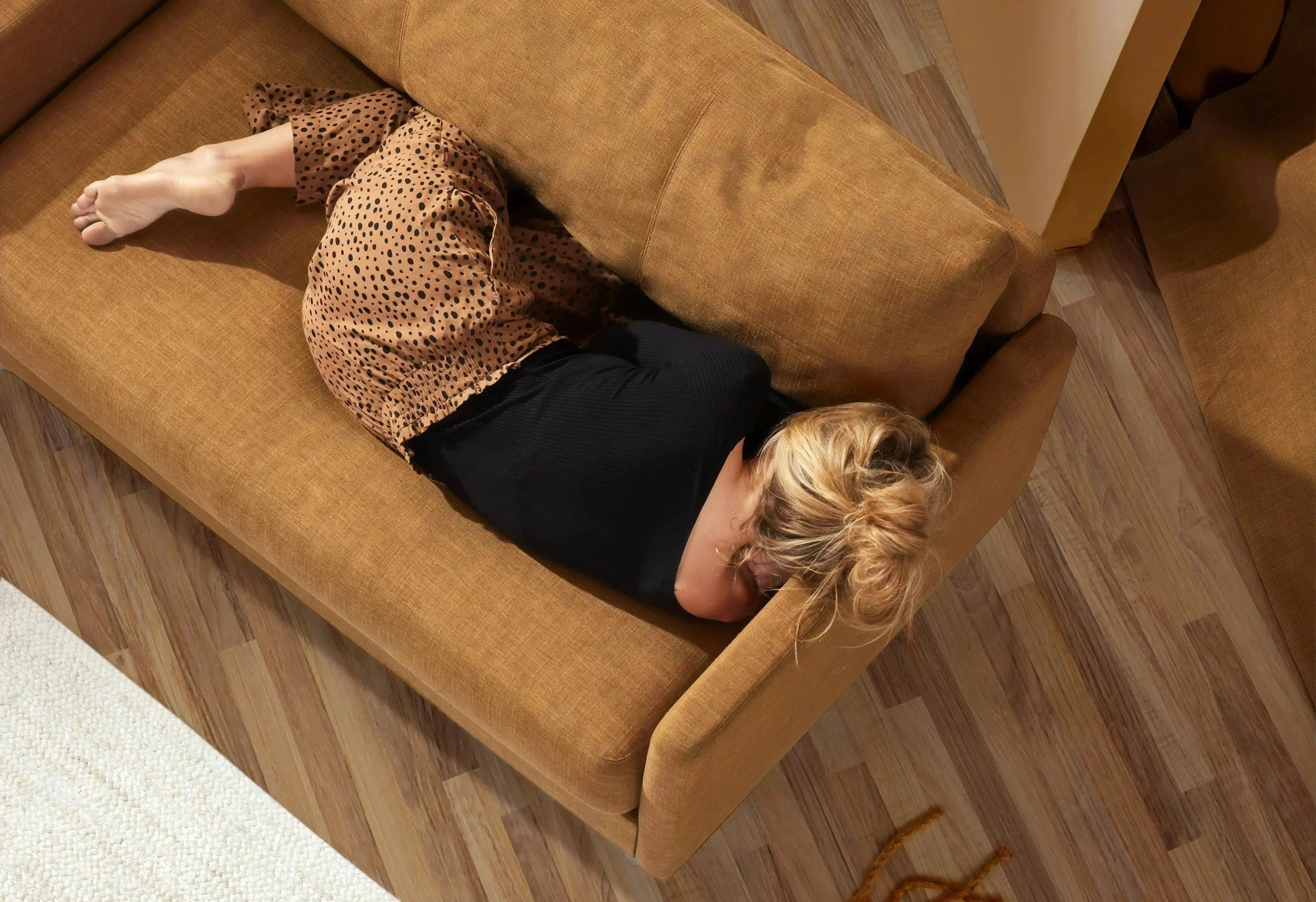
She finally sits down. The kids are occupied, the to-do list is still running in her head, and instead of feeling relief she feels restless. Uncomfortable. Like she should be doing something. Like sitting here is somehow falling behind.
So she picks up her phone. Or starts mentally reorganizing the pantry. Or adds three things to tomorrow's list.
Because sitting still — really, truly still — feels almost impossible. And if she's honest, it feels a little wrong.
If that's you — you're not alone. And you're not lazy. You're living in a culture that has convinced you that your worth is measured by your output. And that belief — however unconscious — is costing your body more than you realize.
WHERE DID THIS BELIEF COME FROM?
This isn't a character flaw. It's a cultural inheritance.
We live in a world that celebrates busy, rewards productivity, and judges stillness. "What did you do today?" is a loaded question for most women — because the honest answer of "I rested" never feels like enough.
For Christian women there's an additional layer — the sense that she should always be serving, giving, producing something for others. Rest can feel almost selfish when there are people who need her. When the laundry is still in the dryer. When the emails haven't been answered. When there is always, always something more to do.
So she keeps going. And going. And going.
Until her body forces the stop she wouldn't give herself.
And even then — even when she's flat on her back with exhaustion — part of her is still making a mental list.
WHAT THIS BELIEF DOES TO YOUR BODY
Here's what most women don't realize — the inability to rest isn't just a mindset issue. It becomes a physiological one.
When your nervous system is chronically activated — always in output mode, always producing, always moving — it loses its ability to shift into a restorative state. Even when you do stop, your body doesn't know how to receive the rest. Your mind keeps running. Your body stays tense. You wake up from sleep still tired and wonder what is wrong with you.
Nothing is wrong with you.
This is what happens when a nervous system has been in a state of constant activation for too long. It forgets how to downshift. It loses the ability to move from doing into being — because doing has become the only thing it knows.
And here's the part that might sting a little:
The rest you keep postponing is the very thing your body needs to function well. To digest properly. To regulate hormones. To think clearly. To have the energy you've been chasing through every supplement and protocol.
Rest isn't the opposite of productivity. It is the foundation of it.
And God knew that long before any of us had to figure it out.
WHAT GOD SAYS ABOUT REST
God didn't suggest rest. He modeled it.
After the work of creation was complete — after He spoke light into darkness, separated the waters, filled the earth with living things, and breathed life into humanity — God rested. Not because He was tired or depleted. But because rest was part of the design. It was woven into the rhythm of creation with intention and purpose.
And then He made it a commandment.
The Sabbath wasn't optional. It wasn't a reward for a sufficiently productive week. It was a non-negotiable rhythm written into the law — because God understood what we keep forgetting: we were not made to run without stopping.
And then there is Jesus — who carried the weight of the most important work ever done in human history — and still withdrew regularly. He stepped away from the crowds, from the demands, from the people who needed Him desperately. He rested. He prayed in solitude. He slept in a boat during a storm while the waves crashed around Him.
That is not incidental. That is instructional.
He invites us into the same:
"Come to me, all you who are weary and burdened, and I will give you rest." Matthew 11:28 ESV
This was not a suggestion. It was a personal invitation — from Jesus himself — to stop carrying what we were never meant to carry alone. To lay it down. To receive what He so freely offers.
Rest is not laziness. It is not indulgence. It is not falling behind.
It is obedience. It is trust. It is wisdom.
MY STORY
I know what it feels like to sit down and immediately feel like you should be doing something else.
During my years of health striving, rest felt almost dangerous. If I stopped monitoring, stopped researching, stopped staying ahead of every potential symptom — what would happen? Would everything fall apart? Would I get worse?
So I kept moving. Kept doing. Kept producing the appearance of progress even when my body was begging me to stop.
And when I did finally sit down — when exhaustion won — I couldn't actually rest. My mind was still running. My body was tense. I would wake up from a full night of sleep and still feel depleted, still feel behind, still feel like I hadn't done enough.
The rest I was getting wasn't reaching me. Because my nervous system didn't know how to receive it.
What began to change things wasn't a new supplement or a better sleep protocol. It was permission. Permission I had to consciously, deliberately give myself — over and over again — to stop. To be still. To trust that the world would not fall apart if I put down the mental load for a few minutes.
It felt uncomfortable at first. Unnatural. Even a little irresponsible.
And then slowly — gradually — it began to feel like coming home.
WHAT REST ACTUALLY LOOKS LIKE IN A REAL, FULL LIFE
I want to be honest with you here — I am not talking about long, uninterrupted afternoons of solitude. I imagine what your life looks like. I live a full life too.
Rest in a real life looks like this:
5-10 minutes of genuine stillness in the middle of your day. Phone away, eyes closed, no agenda. Just being. Even this small act begins to shift your nervous system toward a more restorative state.
Sitting outside without your phone. Fresh air, natural light, no scrolling. Let your eyes rest on something that isn't a screen. Let your nervous system exhale.
A full night of sleep treated as non-negotiable. Not the first thing you sacrifice when life gets full. Sleep is when your body does its most significant restoration work — protect it accordingly.
One slower morning per week. Not every morning needs to be maximized. One morning where you move at a gentler pace, linger a little longer with Jesus, and don't rush toward the day.
Saying no to one thing that would have depleted you. Rest is not only about what you add. Sometimes it's about what you choose not to take on.
And the most important thing I want you to hear:
Rest is not something you earn. It is something you were designed for. You don't have to be productive enough to deserve it. You don't have to finish the list first. You don't have to justify it to anyone — including yourself.
You just have to receive it.
THE REFRAME
The woman who rests is not falling behind. She is building something — a nervous system that can sustain her, a body that can restore itself, a life that doesn't run on empty.
God built rest into the fabric of creation because He knew you would need it. Not someday. Not after everything is finally done. Not when the kids are older or the season gets easier.
Now.
You were not made to sprint forever. And you were never meant to feel guilty for stopping.
A PRAYER FOR YOU
Heavenly Father,
Even though I don’t personally know the woman that is reading this post, I know that you do. You know her deeply and intimately and you know her full story and what her everyday life looks like. Lord, I just ask that you remind her that she has permission to take rest when she needs it and that she can turn to you at any moment, asking for your help and to drop her burdens keeping her from rest at your feet. Please fill her with the kind of peace that only you can give, Father, and restore her so that she can give from a place of being filled by your Spirit.
We love you, Jesus, and it is in your beautiful name that we pray.
Amen.
With grace and 🤍,
Brynn
A note before you go: I am a certified Health and Wellness Coach, not a licensed medical professional. Everything I share here reflects my personal experience and is offered for educational and informational purposes only — not as a substitute for professional medical, mental health, or dietary advice.
If you are navigating a serious or chronic health condition, please continue working closely with your licensed healthcare providers. Never discontinue or modify prescribed treatments or medications without their guidance.
This blog exists to support women who are experiencing nervous system overwhelm and frustrating health symptoms and who are looking for a more peaceful, rhythm-based approach to wellness. It is not intended to diagnose, treat, cure, or prevent any medical condition.